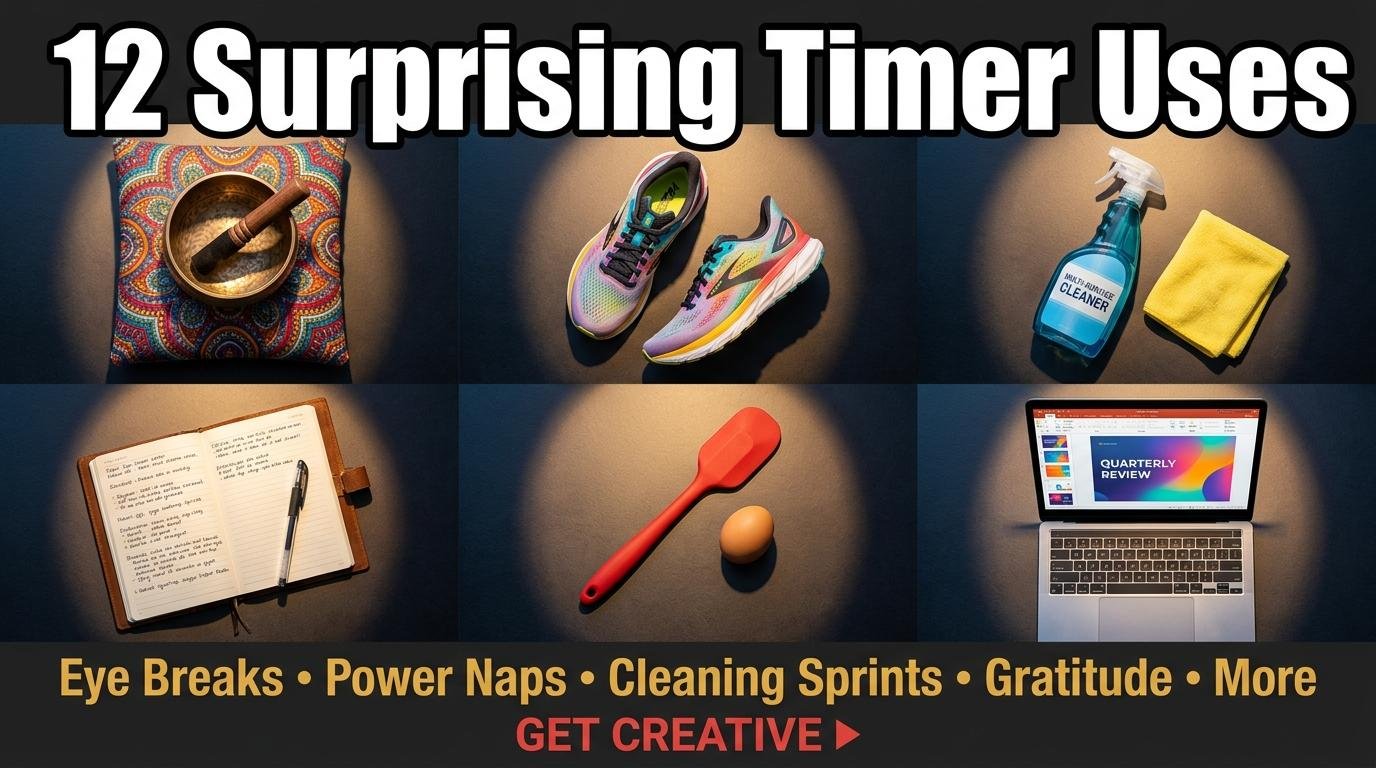
Most people use online timers for cooking eggs and Pomodoro study sessions. But a free browser-based timer is one of the most versatile tools available on any device, and its potential applications extend far beyond the obvious. Here are twelve creative uses that can improve your daily routines, health, productivity, and even your relationships.
1. The 20-20-20 Eye Break Timer
For every 20 minutes of screen work, look at something 20 feet away for 20 seconds. This evidence-based rule prevents the digital eye strain that causes screen time headaches. Set a 20-minute repeating timer and let the alarm remind you to look away. It takes less than a week for this habit to become automatic, and the reduction in end-of-day headaches is noticeable almost immediately.
2. Presentation Pace Keeper
Whether you are presenting in a meeting, giving a speech, or defending a thesis, a visible countdown timer keeps you on pace. Set the timer to your allocated time and position it where you can see it while speaking. The fullscreen countdown is readable from across a stage or conference room. Many speakers who struggle with running over their time limit find that a visible countdown is the only intervention that consistently works.
3. Gratitude Journaling Timer
Gratitude journaling is one of the most well-researched positive psychology interventions, but many people abandon the practice because they feel pressure to write extensively. Set a 3-minute timer and write whatever comes to mind about things you are grateful for. When the timer rings, stop. Three minutes is enough to capture the benefit without the practice feeling like a chore. Do this daily and the compound effect on wellbeing is measurable within two weeks.
4. Toddler Transition Timer
Transitions are the hardest part of parenting a toddler. “Time to leave the playground” triggers meltdowns not because children are defiant but because they cannot process sudden changes. Set a 5-minute visual countdown and show it to your child. “When this timer reaches zero, we put on our shoes.” The countdown makes the transition predictable, which dramatically reduces resistance. Many parents report this single technique transforms their daily routines.
5. Intermittent Fasting Tracker
If you practice intermittent fasting with a 16:8 protocol (16 hours fasting, 8-hour eating window), set an event countdown to the end of your fasting window. Watching the hours count down provides motivation during the difficult final hours of a fast and removes the constant clock-checking that makes fasting feel longer than it is.
6. Power Nap Guard
A 15 to 20-minute power nap boosts alertness and cognitive performance, but sleeping longer than 25 minutes risks entering deep sleep and waking up groggy. Set a 20-minute timer with a gentle alarm sound before lying down. The timer ensures you wake up refreshed rather than disoriented. Choose the Gentle Chime or Morning Birds sound for a pleasant wake-up rather than the jarring Urgent Alarm.
7. Cleaning Sprint Motivator
The hardest part of cleaning is starting. Set a 10-minute timer and clean as much as possible before it rings. The time pressure creates urgency that overcomes procrastination, and the short duration makes the task feel manageable. Ten minutes of focused cleaning accomplishes more than most people expect, and the visible results often motivate continuing past the timer.
8. Meeting Agenda Enforcer
Meetings that run over their scheduled time waste everyone’s productivity. Use ScreenTimer’s Multi Timer to set a separate countdown for each agenda item. When a topic’s timer runs out, the group moves on. This forces concise discussion and ensures every topic receives its allocated time rather than the first topic consuming the entire meeting.
9. Music Practice Segment Timer
Effective music practice divides session time into focused segments: technique exercises, sight-reading, repertoire work, and improvisation. Use the Multi Timer or the interval timer to create structured practice blocks. Set 15 minutes for scales, 15 minutes for sight-reading, and 20 minutes for repertoire. The timer prevents you from spending the entire session on the parts you enjoy while neglecting the fundamentals that actually build skill.
10. Social Media Detox Timer
If you want to reduce social media usage, set a 15-minute timer every time you open a social media app. When the timer rings, close the app. This creates a hard boundary that prevents the “just five more minutes” scroll that turns a quick check into an hour-long session. Over time, the fixed window trains your brain to get the social media fix it wants within a bounded timeframe.
11. Date Night Conversation Timer
This sounds unromantic until you try it. Set a 5-minute timer where one partner speaks uninterrupted about their day, thoughts, or feelings. When the timer rings, switch. The structure prevents the common pattern where one partner dominates the conversation while the other disengages. Therapists have used timed speaking exercises for decades because they create space for both partners to feel heard.
12. Holiday Excitement Countdown
Set up an Event Countdown to your next vacation, holiday, or special event. Display it on a family screen or share the link with everyone involved. Watching the days decrease builds anticipation and gives everyone a shared reference point. Children especially love seeing the day counter go down. Popular countdowns include Christmas 2026 and New Year 2027.
The best timer is the one you integrate into your daily routine. Pick two or three ideas from this list that resonate with your life, set the timers today, and see how structured time boundaries change your experience. Every use case above works with ScreenTimer’s free online timer — no download, no account, just open and start.

Leave a Reply