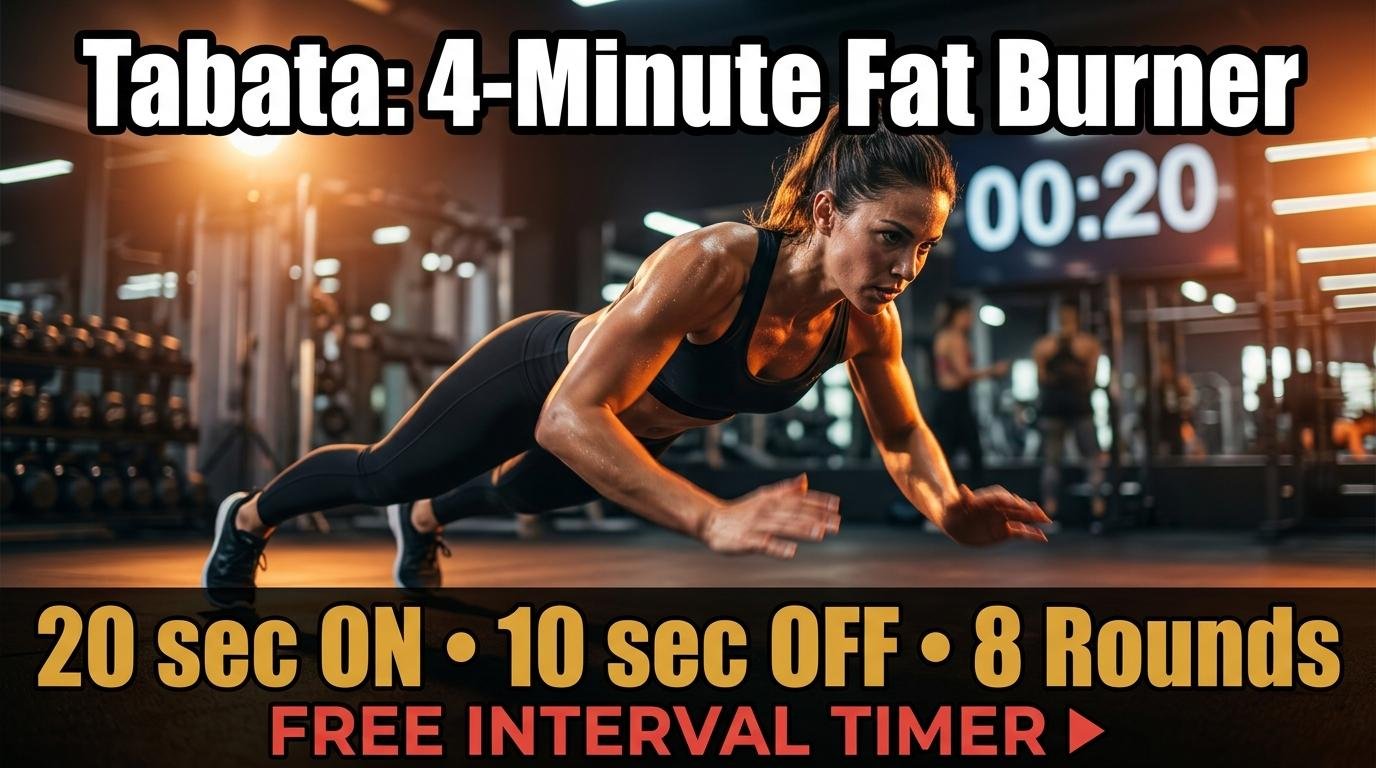
In 1996, Japanese researcher Dr. Izumi Tabata published a study that changed how athletes and fitness enthusiasts approach interval training. His protocol was remarkably simple: 20 seconds of all-out effort followed by 10 seconds of rest, repeated 8 times, for a total of just 4 minutes. The results showed that this brief but intense routine improved both aerobic and anaerobic capacity more effectively than moderate-intensity exercise performed for significantly longer durations.
Three decades later, the Tabata protocol remains one of the most researched and widely used high-intensity interval training methods in the world. Its appeal is obvious: maximum physiological benefit in minimum time. But the simplicity of the protocol hides a critical requirement. The timing must be exact, and the intensity must be absolute. Without both, it is just a hard workout rather than a Tabata workout.
The Science Behind Tabata Training
The original study compared two groups of athletes over six weeks. The first group performed moderate-intensity cycling at 70 percent of VO2max for 60 minutes, five days per week. The second group performed the Tabata protocol at 170 percent of VO2max for just 4 minutes, four days per week. At the end of the study, the moderate group improved their aerobic capacity but showed no improvement in anaerobic capacity. The Tabata group improved both: aerobic capacity increased and anaerobic capacity jumped significantly.
This dual adaptation is what makes Tabata unique. Most training methods improve either aerobic or anaerobic systems, not both. The mechanism is the extreme oxygen debt created by the 20/10 intervals. During each 20-second burst, your muscles demand far more oxygen than your cardiovascular system can deliver, forcing both energy systems to adapt simultaneously during recovery.
How to Structure a Tabata Workout
A proper Tabata workout follows a strict structure. Warm up thoroughly for 5 to 10 minutes with light cardio and dynamic stretching. This is non-negotiable since jumping into maximum effort with cold muscles is a recipe for injury. Select one or two exercises that engage large muscle groups and allow safe maximum effort. Bodyweight squats, burpees, mountain climbers, kettlebell swings, rowing, and cycling are all excellent choices. Avoid exercises with complex form requirements like barbell snatches or pistol squats, where fatigue-induced form breakdown could cause injury.
Set your interval timer for 20 seconds of work and 10 seconds of rest, repeating 8 rounds. During each 20-second work interval, give everything you have. The intensity should be uncomfortable enough that you could not hold a conversation, let alone maintain it for a full minute. During the 10-second rest, breathe deeply and prepare mentally for the next round. After all 8 rounds, cool down with 5 minutes of light movement and static stretching.
Common HIIT Interval Variations
The Tabata protocol is just one approach to interval training. Several other evidence-based ratios target different physiological adaptations.
For fat loss, a 1:1 ratio of 30 seconds work to 30 seconds rest for 20 rounds (total 20 minutes) keeps your heart rate elevated in the optimal fat-burning zone while allowing enough recovery to maintain intensity throughout the session. This ratio works well for exercises like kettlebell swings, box jumps, and battle ropes.
For explosive power development, a 1:3 ratio of 15 seconds of maximum effort followed by 45 seconds of rest for 10 to 12 rounds targets the ATP-CP energy system. This is the training method used by sprinters, combat athletes, and team sport players who need repeated short bursts of explosive movement with full recovery between efforts.
EMOM (Every Minute on the Minute) training takes a different structural approach. At the top of each minute, perform a prescribed number of reps of an exercise. Your rest period is whatever time remains in that minute after completing the reps. As fatigue accumulates across a 10 to 20 minute EMOM session, rest periods naturally shrink, creating an elegant form of progressive overload. A simple stopwatch with lap function works perfectly for tracking EMOM intervals.
Timing Is Everything
The single biggest mistake people make with Tabata and interval training is imprecise timing. Counting in your head during intense exercise is unreliable because perceived time distorts under physical stress. Ten seconds of rest feels like three seconds when you are gasping for air, and twenty seconds of work feels like a minute. An interval timer eliminates this distortion and ensures every work and rest period is exact.
ScreenTimer’s countdown timer with the repeat function enabled is ideal for Tabata workouts. Set it to 20 seconds, enable the last-10-second tick sounds for an audible countdown, and turn on auto-repeat. For more complex interval structures, use the Multi Timer to program different work and rest durations for circuit-style workouts.
Whether you are a beginner exploring interval training or an experienced athlete looking to optimize your protocol, the principle remains the same: precise timing produces precise results. Remove the guesswork, trust the timer, and focus all your energy on the effort itself.

Leave a Reply