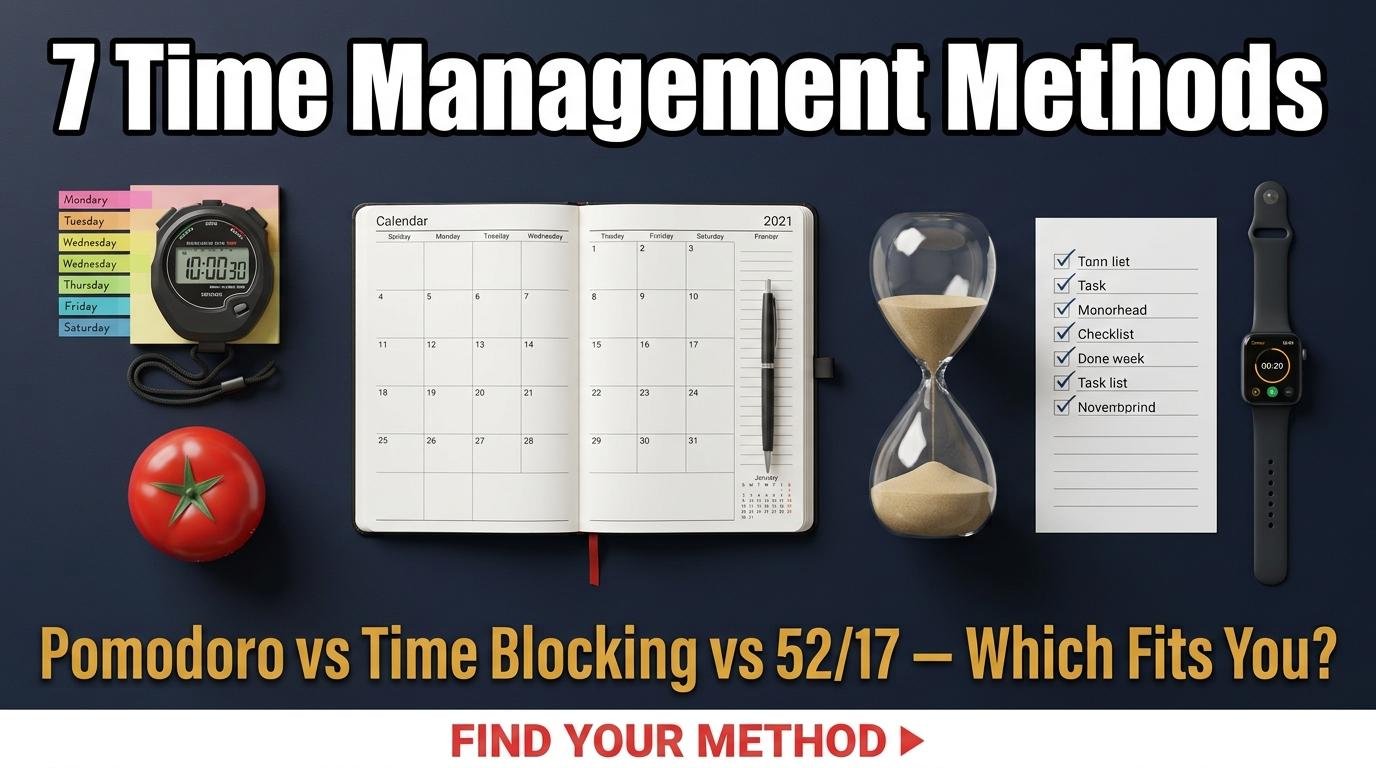
Productivity advice is everywhere, but most of it fails to acknowledge a fundamental truth: different brains work differently. The time management technique that transforms one person’s workday may be completely wrong for another. This guide breaks down seven proven methods with honest assessments of who each one actually works for, so you can choose based on your personality and work style rather than internet hype.
1. The Pomodoro Technique (25/5 Intervals)
The Pomodoro method uses fixed 25-minute focus blocks separated by 5-minute breaks with a longer break after every four sessions. It works best for people who struggle with starting tasks, get easily distracted, or tend to work for hours without breaks and then crash. The structure removes the need for self-regulation by outsourcing timing decisions to the method itself. Use ScreenTimer’s Pomodoro timer for automatic phase transitions.
It works poorly for people who regularly enter flow states that last longer than 25 minutes. Interrupting deep creative work to take a forced break can feel counterproductive if you are a developer, writer, or designer who needs extended unbroken concentration.
2. Time Blocking
Time blocking assigns every hour of your day to a specific task or category of work in advance. Instead of a to-do list, your calendar becomes your work plan. It works best for managers, executives, and anyone whose day involves many different types of tasks. The act of pre-committing time to specific activities prevents reactive work (responding to whatever seems urgent) from crowding out proactive work (the important things that actually move projects forward).
It works poorly for people with highly unpredictable days where priorities shift frequently, or for roles where responsive work is the primary function, like customer support or emergency services. Rigid time blocks create stress rather than structure when constant interruptions are part of the job.
3. The Two-Minute Rule
From David Allen’s Getting Things Done methodology: if a task will take less than two minutes, do it immediately rather than adding it to your task list. The rule prevents small tasks from accumulating into an overwhelming backlog. It works best for people who feel buried under dozens of small action items and spend more time managing their to-do list than actually completing tasks.
It works poorly when used without discipline. If you apply the two-minute rule indiscriminately during a focused work session, every incoming small task becomes an interruption. The rule is meant for processing your inbox or task list, not for responding to every ping that arrives during deep work.
4. Eat the Frog
Attributed to a Mark Twain quote, this method means doing your hardest, most important task first thing in the morning before anything else. The logic is that willpower and decision-making capacity are highest early in the day and degrade as the day progresses. It works best for people who procrastinate on important tasks by staying busy with easier ones, and for those who do their best cognitive work in the morning.
It works poorly for people who are not morning people. If your peak energy and focus arrive in the afternoon or evening, forcing yourself to tackle the hardest task at 8 AM is fighting against your biology rather than leveraging it. Use a stopwatch to track when you do your best work across several days, then schedule your hardest task during that peak window.
5. The Eisenhower Matrix
This framework sorts tasks into four quadrants based on urgency and importance: urgent and important (do immediately), important but not urgent (schedule), urgent but not important (delegate), and neither (eliminate). It works best for leaders and decision-makers who need to prevent urgent but unimportant tasks from crowding out strategic work.
It works poorly as a daily task management system. The matrix is a prioritization framework, not a time management method. You still need a separate technique for actually executing the tasks once they are categorized. Combine it with time blocking or Pomodoro for execution.
6. The 52/17 Rule
Based on data from the time-tracking app DeskTime, this method uses 52 minutes of focused work followed by 17-minute breaks. The longer work sessions allow deeper focus than Pomodoro’s 25-minute blocks, while the longer breaks provide more meaningful recovery. It works best for knowledge workers doing creative or analytical tasks that require extended concentration, like writing, coding, analysis, or design.
It works poorly for people who need more frequent breaks due to physical discomfort, attention difficulties, or roles that require frequent task switching. Set a 52-minute countdown and experiment with this ratio to see if it matches your natural work rhythm.
7. Timeboxing
Timeboxing sets a fixed maximum duration for a task rather than working until it is done. If you timebox “email processing” to 30 minutes, you stop at 30 minutes regardless of whether you have processed every email. This method works best for perfectionists and people who over-invest time in tasks that have diminishing returns. It creates healthy constraints that force prioritization within the box.
It works poorly for tasks with hard quality requirements where stopping at an arbitrary time produces unacceptable results. Writing code that must work, preparing legal documents that must be accurate, or cooking a meal that must reach a specific internal temperature are not suitable for strict timeboxing.
How to Choose Your Method
Rather than committing to a single technique, most productive people blend elements from several methods. A common combination is the Eisenhower Matrix for weekly prioritization, time blocking for daily scheduling, and Pomodoro or 52/17 for execution within each block. The key is experimenting with each method for at least two full weeks before deciding whether it works for you. One day is not enough data to evaluate a new system.
ScreenTimer provides the timing infrastructure for all seven methods. The Pomodoro timer, countdown timer, stopwatch, and multi-timer cover every timing need across all these techniques, free and accessible from any browser.

Leave a Reply